
 Image 1 of 1
the Lyon (the outlaw) Woolace 1804 (coming soon)
The Outlaw of Vinegar Hill: Lyon Woolace (1804)
The "Woolace" name was more than a moniker; it was a curse or a rallying cry, depending on who you asked. For twenty-four years after Lyon the Great uprooted the March Stone in 1780, the glens of the North held. But the "white tide" of Cheviot sheep was a bureaucracy with an army, and it eventually washed over everything.
The survivors were scattered. Many, having taken the 'Death or Liberty' rally call too literally during small protests, found themselves not in coastal slums, but on ships. This is how the "Woolace bloodline" came to the newly-established penal colony of New South Wales.
A New Land, An Old Fight (1804)
By 1804, the glens of Scotland were a memory. Instead, the focus was on the harsh Government Farms at Castle Hill, outside Parramatta. Here, Irish convicts—many of them political prisoners from the 1798 Rebellion—toiled under the brutal New South Wales Corps, known simply as the "Redcoats."
And among them was the "next ram." Not a golden titan, but Lyon "The Outlaw" Woolace, a direct descendant of The Great ram.
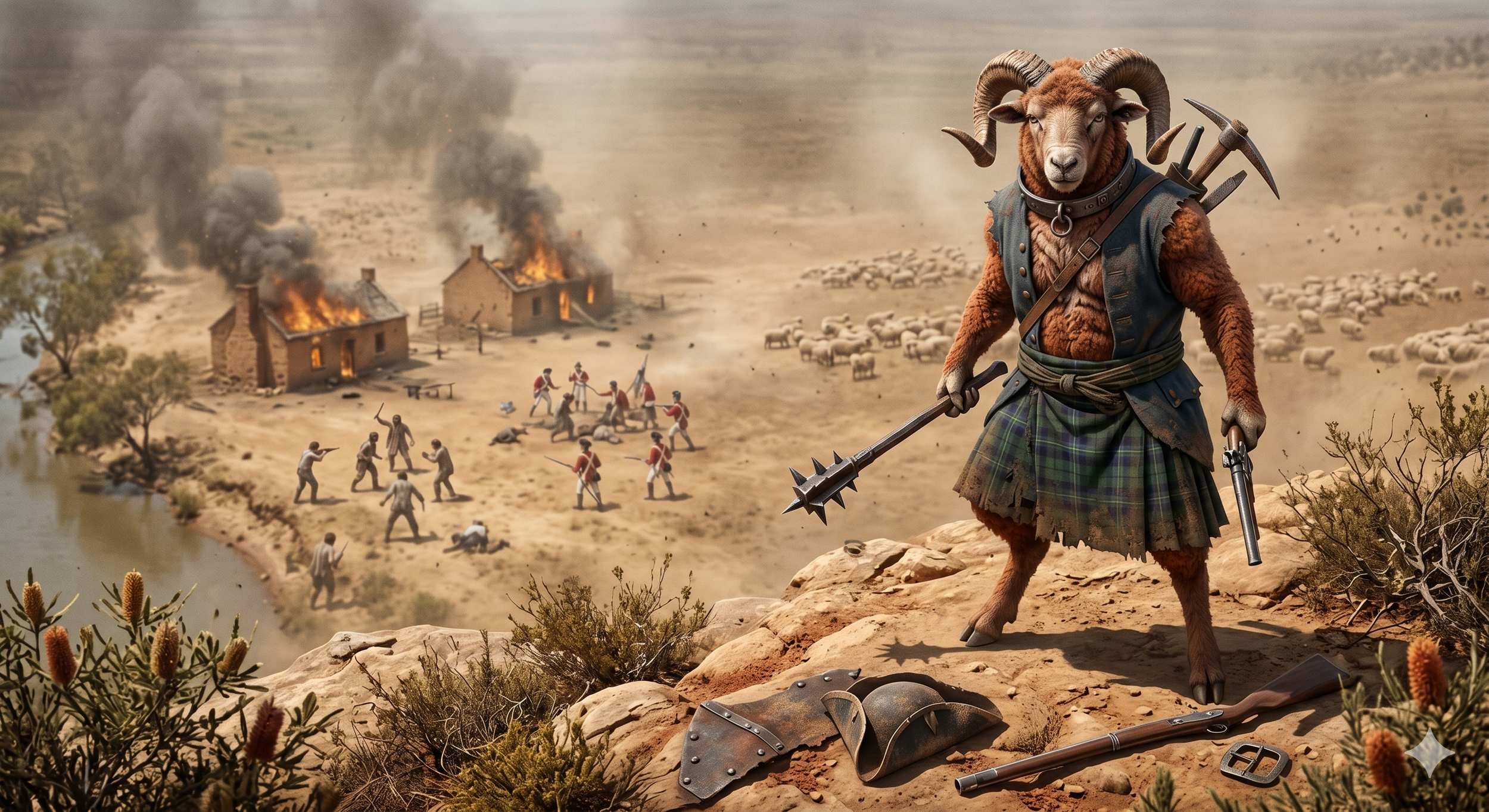
While his ancestor wore a captured Minuteman coat as a symbol of revolutionary crossover, The Outlaw wore nothing but defiance and a heavy iron collar with 'No. 76' stamped into it. He was a smaller, leaner, more rugged ram, with a coat of gritty, rust-colored wool, stained by red Australian dust. His horns were not perfect wide spirals, but smaller, forward-sweeping, and jagged, chipped from years of use as improvised tools and weapons.
Australia's Vinegar Hill
On the night of March 4, 1804, a signal fire at Castle Hill ignited the first fully-fledged convict uprising in Australian history.Three hundred convicts overpowered their guards, aiming to take Parramatta, then march on Sydney to "capture ships to sail to Ireland." Their slogan, too, was 'Death or Liberty, and a ship to take us home.'
For a day, the colony panicked. But disorganization and the betrayal of a key messenger left the rebels cornered on a hillock, which they defiantly dubbed Vinegar Hill, after the site of their 1798 defeat in Ireland. Major George Johnston and the New South Wales Corps pursued them with a fury.
The Tollgate of the South (1804)
When Major Johnston demanded surrender, the rebel leaders refused. As Government forces prepared to fire, Lyon the Outlaw separated himself from the group of convicts.
He did not stand on two legs; he dropped to four, his hooves dug into the Australian clay. With a single, explosive, gritty bleat that was more of a war-bellow, he charged. He wasn't aiming for the redcoats. He aimed for their command.
The first line of soldiers broke. He used his head as a battering ram, toppling three redcoats. He intercepted a bullet meant for the Irish rebel leader, Philip Cunningham, the ball embedding in his massive, iron-stiffened fleece. In a desperate act, he locked his horns with a redcoat and threw the man into the dust.
His actions didn't save the rebellion; historically, it was a disaster. But he was The Outlaw, a force that could not be shorn by logic, paper, or penal rules. He proved that even on the other side of the world, the Woolace bloodline was still a tollgate.
Lyon’s word
“The King’s men think the ocean washed the rebel out of the Woolace name, but all it did was salt the fire. You brought us to this red desert to break our backs, but you’ve only given us a harder ground to stand on. This isn't a farm, Major—it's a graveyard for your empire. Death or Liberty!”
The Outlaw of Vinegar Hill: Lyon Woolace (1804)
The "Woolace" name was more than a moniker; it was a curse or a rallying cry, depending on who you asked. For twenty-four years after Lyon the Great uprooted the March Stone in 1780, the glens of the North held. But the "white tide" of Cheviot sheep was a bureaucracy with an army, and it eventually washed over everything.
The survivors were scattered. Many, having taken the 'Death or Liberty' rally call too literally during small protests, found themselves not in coastal slums, but on ships. This is how the "Woolace bloodline" came to the newly-established penal colony of New South Wales.
A New Land, An Old Fight (1804)
By 1804, the glens of Scotland were a memory. Instead, the focus was on the harsh Government Farms at Castle Hill, outside Parramatta. Here, Irish convicts—many of them political prisoners from the 1798 Rebellion—toiled under the brutal New South Wales Corps, known simply as the "Redcoats."
And among them was the "next ram." Not a golden titan, but Lyon "The Outlaw" Woolace, a direct descendant of The Great ram.
While his ancestor wore a captured Minuteman coat as a symbol of revolutionary crossover, The Outlaw wore nothing but defiance and a heavy iron collar with 'No. 76' stamped into it. He was a smaller, leaner, more rugged ram, with a coat of gritty, rust-colored wool, stained by red Australian dust. His horns were not perfect wide spirals, but smaller, forward-sweeping, and jagged, chipped from years of use as improvised tools and weapons.
Australia's Vinegar Hill
On the night of March 4, 1804, a signal fire at Castle Hill ignited the first fully-fledged convict uprising in Australian history.Three hundred convicts overpowered their guards, aiming to take Parramatta, then march on Sydney to "capture ships to sail to Ireland." Their slogan, too, was 'Death or Liberty, and a ship to take us home.'
For a day, the colony panicked. But disorganization and the betrayal of a key messenger left the rebels cornered on a hillock, which they defiantly dubbed Vinegar Hill, after the site of their 1798 defeat in Ireland. Major George Johnston and the New South Wales Corps pursued them with a fury.
The Tollgate of the South (1804)
When Major Johnston demanded surrender, the rebel leaders refused. As Government forces prepared to fire, Lyon the Outlaw separated himself from the group of convicts.
He did not stand on two legs; he dropped to four, his hooves dug into the Australian clay. With a single, explosive, gritty bleat that was more of a war-bellow, he charged. He wasn't aiming for the redcoats. He aimed for their command.
The first line of soldiers broke. He used his head as a battering ram, toppling three redcoats. He intercepted a bullet meant for the Irish rebel leader, Philip Cunningham, the ball embedding in his massive, iron-stiffened fleece. In a desperate act, he locked his horns with a redcoat and threw the man into the dust.
His actions didn't save the rebellion; historically, it was a disaster. But he was The Outlaw, a force that could not be shorn by logic, paper, or penal rules. He proved that even on the other side of the world, the Woolace bloodline was still a tollgate.
Lyon’s word
“The King’s men think the ocean washed the rebel out of the Woolace name, but all it did was salt the fire. You brought us to this red desert to break our backs, but you’ve only given us a harder ground to stand on. This isn't a farm, Major—it's a graveyard for your empire. Death or Liberty!”